The Rock That Gave a Waterfall Its Name—Then Vanished
Twelve kilometers from Shillong's bustling Police Bazaar, down a winding road through subtropical pine forests and terraced hillsides, lies one of Meghalaya's most photographed waterfalls. The British called it Elephant Falls, naming it after a massive rock formation resembling a tusked giant that once stood sentinel beside the cascades. That rock—destroyed in the catastrophic 1897 Assam earthquake—has been gone for over a century. Yet the name stuck, even as locals continued to use its original Khasi name: Ka Kshaid Lai Pateng Khohsiew, "The Three Step Waterfall" (Wikipedia, 2026; Incredible India, 2026).
Today, Elephant Falls draws hundreds of visitors daily—families on weekend picnics, couples chasing Instagram moments, photographers hunting the perfect interplay of light through fern-covered rocks. It's accessible, well-maintained, and close enough to Shillong to fit into any day itinerary. But is it worth the hype, or just another over-touristed cascade trading authenticity for convenience?
Let's descend the 150 slippery steps and find out.
The Three Tiers: A Cascade in Three Acts
The Geology and Flow
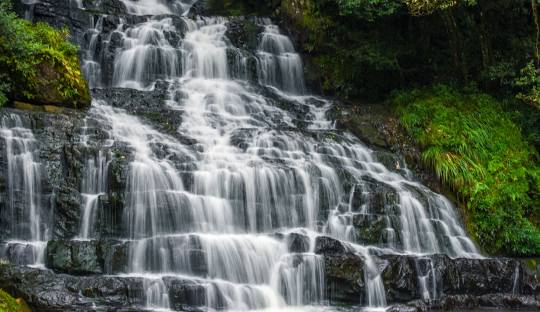
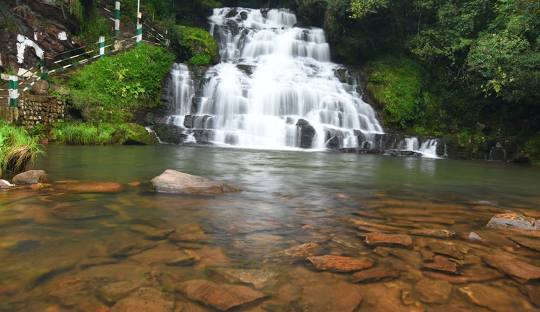
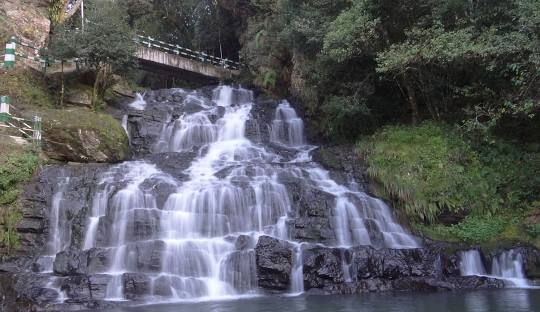
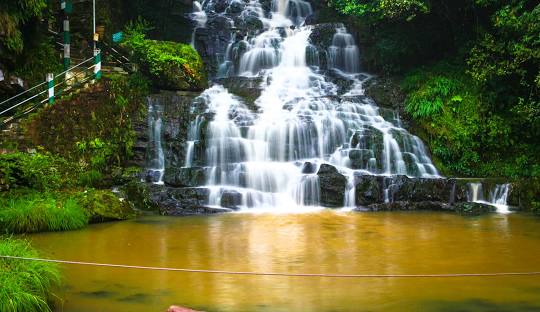
Elephant Falls isn't a single dramatic plunge—it's a three-tiered descent totaling approximately 310 meters (1,017 feet) in cumulative height, though individual tier heights vary (Testbook, 2026). The water flows from mountain streams originating in the East Khasi Hills' subtropical broadleaf forests, tumbling over sedimentary rock formations shaped by millennia of erosion.
Tier by Tier:
- First Tier (Hidden Falls): 20–30 steps down from the entrance; widest cascade, often partially obscured by dense vegetation; best monsoon flow
- Second Tier (Râpet Falls): Additional 15–20 steps; narrow chute through moss-covered rocks; popular photography spot
- Third Tier (Main Elephant Falls): Final 30–40 steps; most dramatic drop; misty spray zone; fern-covered cliff walls
The monsoon season (June–September) transforms the falls into a roaring spectacle, with peak flow in July–August. During winter (December–February), water levels recede significantly—some visitors report the falls looking "disappointing" or "barely flowing" in January (TripAdvisor, 2026). Spring (March–May) offers a middle ground: moderate flow with pleasant weather.
The Fern-Covered Fantasy
What makes Elephant Falls visually striking isn't just the water—it's the emerald tapestry of vegetation clinging to every rock surface. The East Khasi Hills' subtropical climate (heavy rainfall, high humidity, mild temperatures) creates ideal conditions for:
- Pteridophytes (ferns): Over 50 species thrive in the mist zone, including tree ferns and aquatic varieties
- Bryophytes (mosses and liverworts): Thick carpets covering boulders; crucial for water retention
- Epiphytic orchids: Small species blooming in crevices during spring
- Lichens: Grey-green crusts on exposed rock faces
This biodiversity isn't just aesthetic—it's ecological. The ferns and mosses slow water runoff, prevent erosion, and provide micro-habitats for insects, frogs, and small birds. A Facebook post by VanVagado (2020) noted: "Fern Elephant Falls... Pteridophytes play significant ecological roles, from forest understory plants contributing to biodiversity" (Facebook, 2020).
The 1897 Earthquake and the Lost Elephant
Colonial Naming and Natural Disaster
During the British Raj, colonial officers exploring Meghalaya encountered a massive boulder beside the falls' third tier—a rock formation with uncanny resemblance to an elephant's head, complete with a trunk-like protrusion. They rechristened the Khasi Ka Kshaid Lai Pateng Khohsiew as "Elephant Falls," a name that appeared on official maps and tourist brochures (Grokipedia, 2026; Kiomoi, 2024).
Then, on June 12, 1897, one of the most powerful earthquakes in recorded history struck Assam and the Shillong Plateau—magnitude 8.1, with epicenter near the Chedrang Valley. The quake killed an estimated 1,542 people, flattened buildings across Shillong, and triggered landslides throughout the Khasi Hills. Among the casualties: the elephant-shaped rock at Elephant Falls, shattered beyond recognition (Bilham, 1897 re-evaluation study; Indian Culture, 2026).
Yet the colonial name persisted—a linguistic fossil preserving a geological feature that no longer exists. As one Instagram post from September 2025 poignantly noted: "The falls earned their name during the British era, when a massive rock shaped like an elephant stood beside the cascades. Though the rock was lost in the devastating earthquake of 1897, the name lived on, carrying with it a piece of history" (Instagram, 2025).
The Khasi Name Lives On
Locals never abandoned Ka Kshaid Lai Pateng Khohsiew. The name is descriptive, practical, and rooted in centuries of Khasi oral tradition—no colonial mythology required. Many contemporary tour guides use both names interchangeably, acknowledging the duality: a British label clinging to vanished geology, and a Khasi phrase that simply describes what you see (Tripoto, 2024; Times of India, 2024).
Visiting Elephant Falls: The Ground Truth
Practical Information
Location: Upper Shillong, East Khasi Hills District, Meghalaya
Distance from Shillong: 12 km (30 minutes by taxi from Police Bazaar)
Entry Fee: ₹20 per person (Indians); ₹100 (foreigners); ₹20 (camera); ₹50–₹100 (Khasi traditional costume photo shoot—optional!)
Timings: 9:00 AM – 5:00 PM daily (some sources say 6:00 AM – 6:00 PM; official Meghalaya Tourism lists 6 AM – 6 PM)
Time Needed: 1.5–2 hours (includes all three tiers, photo stops, uphill return)
Getting There:
- From Shillong Police Bazaar: Taxi ₹600–₹800 (one-way); ₹1,200–₹1,500 (return with waiting time, 2–3 hours)
- Shared taxi: Sporadic; inquire at Bara Bazaar taxi stand
- Self-drive: Well-paved road; ample parking (₹20–₹50)
Best Time to Visit:
- June–September (Monsoon): Peak flow; dramatic cascades; slippery steps; crowds on weekends; best for waterfall photography
- October–February (Winter): Reduced flow; clearer skies; pleasant weather (10–20°C); less crowded; best for comfortable hiking
- March–May (Spring): Moderate flow; warm weather (15–25°C); occasional pre-monsoon showers; balanced experience
The 150-Step Descent (and Climb Back Up)
Reality Check: The steps are steep, uneven, and slippery—especially after rain. The descent is manageable for most fitness levels, but the return climb can be strenuous for seniors, young children, or those with knee issues. Benches are placed at intervals, but you'll likely need them.
Step Breakdown (approximate):
- First tier: 20–30 steps
- Second tier: Additional 15–20 steps (cumulative ~50)
- Third tier: Final 30–40 steps (cumulative ~90–100)
- Total (including connecting paths): 120–150 steps each way
Safety Tips (compiled from visitor reviews and official sources):
- Wear non-slip shoes with good grip (not flip-flops or leather soles)
- Use handrails religiously—they're installed for a reason
- Go slowly on descent; most slips occur when rushing
- Carry minimal gear—leave large bags in vehicle
- Watch for moss patches on steps (they're extra slippery)
- Avoid during heavy rain—steps become hazardous
- Seniors/children: Consider stopping at Tier 2 if Tier 3 looks daunting
A TripAdvisor reviewer from May 2025 warned: "Beautiful three step falls with steps all the way down to the third tier. It's not too difficult to go down or to find way up due to railings most of the way, BUT the stairs can be slippery. Senior citizens and children should take special care" (TripAdvisor, 2026).
What People Are Actually Saying
The Honest Reviews
TripAdvisor (2024–2026):
- "Elephant fall is a beautiful 3 tier water fall... Third fall is the best with very good viewing points" (December 2024)
- "The best time to visit the falls would be during monsoon as when we visited it in Jan there was hardly any flow" (January 2026)
- "It's a nice place, well maintained location and the scenic beauty of the site is awesome... There are three falls around the site" (May 2025)
- "Around 120 steps in all and we can complete the visit in around 2 hours. Ticket price 100 and the name came from a rock on one side which resembles an elephant but now it's no more after an earthquake" (2025)
Instagram & Social Media (2024–2025):
- "Elephant Falls – There is no trace of any elephant here, and I don't think any elephants have ever fallen here... but the three-tiered cascade is stunning!" (November 2024)
- "Day 2. Meghalaya. Shillong. Visited the 3 stepped Elephant waterfalls. The weather stalled for us to do the 150 slippery steps down and up... Worth it!" (August 2023)
Facebook (2025):
- "Sadly, that iconic elephant-shaped rock was destroyed in the great earthquake of 1897… yet the name remained, and so did the magic of the falls!" (April 2025)
- "Addictive combination of rainfall and waterfall in Shillong... The elephant falls consist of three layers of falls at three different points which are accessible to the tourist visiting the falls" (October 2018)
Photography Tips from Locals
A Local Guides Connect post from November 2025 shared: "Perfect Photography Spot: As you can see from my shot, the interplay of light and shadow through the dense foliage is a dream for photographers" (Local Guides Connect, 2025).
Best shots:
- Tier 2: Morning light (8:00–10:00 AM) creates sun rays through mist
- Tier 3: Wide-angle lens captures full cascade with fern-framed foreground
- Monsoon: Use fast shutter speed (1/500s+) to freeze water motion; slow shutter (1–2s) for silky flow effect
- Avoid midday: Harsh overhead light washes out details
Crowds and Commercialization: The Trade-Offs
Weekend vs. Weekday Reality
Elephant Falls' proximity to Shillong makes it a magnet for weekend crowds—expect 200–300+ visitors on Saturdays/Sundays during peak season (June–August, December–January). A Kiomoi travel article advised: "The falls can get crowded, especially at some stages at weekends and holidays. To experience a more peaceful trip, plan your go-to early" (Kiomoi, 2024).
Weekday mornings (9:00–11:00 AM) offer the best balance: fewer people, better light, cooler temperatures.
The Commercial Touches
At the entrance, you'll find:
- Khasi costume photo booths: ₹50–₹100 for traditional dress + photo
- Snack vendors: Momos, chips, tea (₹20–₹50)
- Souvenir stalls: Local handicrafts, keychains, postcards
- Restrooms: Basic facilities (₹5–₹10)
Some visitors appreciate the convenience; others lament the "touristy" feel. A balanced perspective: It's accessible tourism done reasonably well—not pristine wilderness, but not Disneyfied either.
Nearby Attractions: Building a Shillong Day Itinerary
Shillong Peak (15 km from Elephant Falls):
Highest point in Shillong (1,965 m); 360° views of city, Bangladesh plains, and Himalayas (on clear days); entry ₹10
Ward's Lake (10 km):
Horseshoe-shaped colonial-era lake; boating, gardens, cafés; entry ₹10
Don Bosco Museum (9 km):
Seven-story indigenous cultures museum; Meghalaya's tribal heritage; entry ₹100
Laitlum Canyons (28 km):
Dramatic gorge viewpoints; trekking; "end of the hills" in Khasi; becoming popular Instagram spot
Sample Half-Day Itinerary (4–5 hours):
- 8:00 AM: Start from Shillong → Elephant Falls (arrive 8:30 AM)
- 8:30–10:30 AM: Explore all three tiers, photos, snacks
- 11:00 AM: Shillong Peak (30 min stop)
- 12:00 PM: Ward's Lake (lunch, boat ride)
- 1:30 PM: Return Shillong or continue to Don Bosco Museum
The Ecological Context: Meghalaya's Subtropical Forests
Elephant Falls sits within the Meghalaya Subtropical Forests ecoregion, part of the Eastern Himalayas biodiversity hotspot. The Khasi and Garo Hills support:
- 5,000+ plant species (including 325 orchids)
- 100+ mammal species (elephants, leopards, slow loris, hoolock gibbons)
- 650+ bird species (25% of India's avifauna)
The forest around Elephant Falls—though disturbed by tourism and roadbuilding—retains pockets of subtropical broadleaf and pine forests, with:
- Pinus kesiya (Khasi pine) dominating upper slopes
- Schima wallichii, Castanopsis, and Lithocarpus (oaks) in valleys
- Extensive epiphytic flora: ferns, mosses, orchids, lichens
According to the Meghalaya Biodiversity Board: "These forests are exceptionally rich in epiphytic flora comprising Ferns, Lichens, Mosses, Orchids, Zingibers, etc." (Meghalaya Biodiversity Board, 2017).
The Verdict: Is Elephant Falls Worth Your Time?
Visit Elephant Falls if you:
- Want an easy, accessible waterfall experience near Shillong
- Have limited time (half-day itinerary)
- Are traveling with family or seniors (manageable steps with breaks)
- Love fern-covered landscapes and subtropical forest ambiance
- Visit during monsoon (June–September) for dramatic water flow
Skip (or lower expectations) if you:
- Seek wilderness solitude—this is a commercial tourist site
- Only have winter dates (December–February)—water flow may disappoint
- Dislike crowds—weekends can feel like rush hour
- Have mobility issues—150 steps with no elevator option
- Compare every waterfall to Nohkalikai or Seven Sisters (Elephant Falls is pretty, not jaw-dropping)
Honest Assessment: Elephant Falls is Shillong's convenient cascade—close, accessible, photogenic, and well-maintained. It won't blow your mind like Cherrapunji's giants, but it delivers on its promise: a pleasant half-day outing blending nature, history, and just enough commercialization to be comfortable. The lost elephant-rock story adds charm; the three-tier descent offers variety; the fern-covered walls satisfy Instagram.
Go with realistic expectations, visit during monsoon or early morning on weekdays, and you'll likely leave satisfied. Go in winter expecting Niagara, and you'll be disappointed.
Essential Information at a Glance
| Category | Details |
|---|---|
| Location | Upper Shillong, East Khasi Hills, Meghalaya |
| Distance from Shillong | 12 km (~30 minutes) |
| Distance from Police Bazaar | 12 km |
| Khasi Name | Ka Kshaid Lai Pateng Khohsiew (Three Step Waterfall) |
| Entry Fee | Indians ₹20; Foreigners ₹100; Camera ₹20 |
| Timings | 9:00 AM – 5:00 PM (some sources: 6 AM – 6 PM) |
| Steps | ~120–150 (steep, slippery) |
| Time Needed | 1.5–2 hours |
| Best Time | June–September (monsoon); October–November (post-monsoon) |
| Difficulty | Moderate (steps challenging for seniors/children) |
| Facilities | Parking, restrooms, snack vendors, souvenir stalls |
| Nearby Attractions | Shillong Peak (15 km), Ward's Lake (10 km), Don Bosco Museum (9 km) |
| Mobile Network | Good (Airtel, Jio, Vodafone) |
| Safety | Non-slip shoes essential; avoid heavy rain; use handrails |
Contacts:
- Meghalaya Tourism: www.meghalayatourism.in
- Shillong Tourism Office: +91-364-2226920
- Emergency: Shillong Police 100; Civil Hospital +91-364-2224047
References & Sources
- Bilham, R. (1897 study). Re-evaluated intensities for the great Assam earthquake of 12 June 1897. University of Colorado. https://cires1.colorado.edu/~bilham/1897.pdf
- Facebook – Bengal Trekkers. (2024, July 2). Elephant Falls captivating waterfall. https://www.facebook.com/groups/bengaltrekkers/posts/1613292112861281/
- Facebook – The Mountains Calling. (2025, April 19). Elephant Falls elephant-shaped rock destroyed 1897. https://www.facebook.com/groups/themountainscalling/posts/10163194687820775/
- Facebook – VanVagado. (2020). Fern Elephant Falls ecological roles. https://www.facebook.com/groups/vanvagado/posts/4168984309820636/
- Grokipedia. (2026). Elephant Falls. https://grokipedia.com/page/Elephant_Falls
- Holidify. (2026). Elephant Falls, Shillong | Timing, Entry Fees, Photos, Tips. https://www.holidify.com/places/shillong/elephant-falls-sightseeing-3475.html
- Hotel Polo Towers. (2026). Elephant Falls in Shillong. https://www.hotelpolotowers.com/blogs/a-trip-to-the-majestic-elephant-falls.html
- Incredible India. (2026). About Elephant Falls Shillong. https://www.incredibleindia.gov.in/en/meghalaya/shillong/elephant-falls
- Indian Culture. (2026). Natural and Built Heritage – Shillong. http://indianculture.gov.in/north-east-archive/capital-cities-north-east-india/shillong/natural-built-heritage
- Instagram. (2024, November 12). Elephant Falls no trace of elephant. @purtyjai. https://www.instagram.com/p/DCR7-JkSYOC/
- Instagram. (2025, September 21). Falls earned name during British era. https://www.instagram.com/reel/DO3ah-dj_tR/
- Kiomoi. (2024, September 5). Experience the Majestic Elephant Falls Shillong. https://www.kiomoi.com/travel-articles/experience-the-majestic-elephant-falls-shillong-meghalaya-153
- Local Guides Connect. (2025, November 27). Majestic Meghalaya: A Local's Dive into Elephant Falls. https://www.localguidesconnect.com/t/majestic-meghalaya-a-locals-dive-into-elephant-falls/495247
- Meghalaya Biodiversity Board. (2017, December 18). Floral Diversity. https://megbiodiversity.nic.in/floral-diversity
- Meghalaya Tourism. (2026). Elephant Falls. https://www.meghalayatourism.in/explore/destinations/by-interest/majestic-waterfalls/elephant-falls/
- Pickyourtrail. (2025, February 26). Elephant falls -Shillong | All you need to know. https://pickyourtrail.com/blog/elephant-falls-in-shillong
- Testbook. (2026). In which state is the Elephant Water Fall located? https://testbook.com/question-answer/in-which-state-is-the-elephant-water-fall-located--65a506eeaa5b38f1e1f6f5f6
- Times of India. (2024, November 10). This waterfall in Shillong is named after an animal. https://timesofindia.indiatimes.com/etimes/trending/this-waterfall-in-shillong-is-named-after-an-animal/articleshow/115123664.cms
- Trawell.in. (2026). Elephant Falls, Shillong - Timings, Entry Fee, Swimming. https://www.trawell.in/meghalaya/shillong/elephant-falls
- TripAdvisor. (2026). Elephant Falls (2026) - All You Need to Know BEFORE. https://www.tripadvisor.com/Attraction_Review-g503702-d501155-Reviews-Elephant_Falls-Shillong_East_Khasi_Hills_District_Meghalaya.html
- Tripoto. (2024). The Story behind Elephant Falls - Shillong. https://www.tripoto.com/meghalaya/trips/the-story-behind-elephant-falls-shillong-5bbb19efb167b
- Wikipedia. (2026). Elephant Falls. https://en.wikipedia.org/wiki/Elephant_Falls
- Yeh Safar Hamara Hai. (2024, December 29). Elephant Falls: Timings, Entry Fees, and More. https://yehsafarhamarahai.com/2024/12/29/elephant-falls/